
It's Tuesday afternoon. You have a management call at 2 PM, a diligence session at 4, and an IC memo due by end of week. The data room has 1,400 documents. Your inbox has seventeen tabs open. You are not short on information — you are short on time to process it.
Private equity work is defined by this tension. The average associate manages multiple live deals simultaneously, each with its own document trail, meeting schedule, and stakeholder map. Most general productivity tools were designed for neither the volume nor the stakes. The AI tools worth using in a PE context are the ones built around that reality — structured research, sensitive conversations, document-intensive workflows, and compliance exposure.
This roundup covers ten tools across five categories, evaluated on their fit for PE workflows: research and market intelligence, meeting intelligence, legal and document work, data room management, and knowledge management.
Research and Market Intelligence
1. AlphaSense
Best for: Buy-side research, earnings analysis, and expert transcript access
AlphaSense is a market intelligence platform that aggregates over 500 million documents — SEC filings, earnings transcripts, broker research, trade publications, and expert call content — and makes them searchable via AI-powered natural language queries. The platform covers more than 17,000 companies and includes 950,000-plus M&A deals and 685,000 funding rounds in its financial data suite. For analysts running sector research or building comp sets, it consolidates sources that would otherwise require manual searching across Bloomberg, SEC.gov, and individual broker portals.
The platform's most distinctive asset for PE is its expert transcript library, significantly expanded through the 2024 acquisition of Tegus. AlphaSense's Wall Street Insights gives access to premium equity research from global bulge-bracket and boutique firms. The Deep Research and Generative Search tools synthesize findings with citations, which matters when you need to validate claims in a memo quickly.
Limitations worth knowing: coverage of private companies — particularly smaller ones — is limited compared to public company depth. AlphaSense is most powerful for public market research and sectors with strong broker coverage; for a private company with no analyst following, it will not fill the gap. The interface has a learning curve, and search results can sometimes be too broad, requiring additional filtering to find what you need. Pricing is enterprise-only, negotiated by contract; per-seat annual costs run roughly $10,000–$20,000, with average enterprise deals in the $125,000 range. Verify pricing directly before budgeting.
Pros: Unmatched content depth for public markets, expert transcript access, AI-synthesized research with citations, GDPR-compliant EU data residency option.Cons: Expensive, limited private company coverage, steep learning curve for new users, not designed for document workflows outside of research.
2. Perplexity
Best for: Fast sourcing, background research, and real-time information retrieval
Perplexity is an AI-powered search engine that synthesizes answers from live web sources and returns cited responses. For PE analysts, the practical use case is quick background research: pulling recent news on a portco, checking a competitor's latest funding round, or getting a fast summary of regulatory changes in a target sector. It is not a replacement for AlphaSense on depth, but it is fast, sourced, and cheap.
Enterprise Pro is available at $40 per seat per month, which includes SSO, compliance certifications, and a no-training-on-user-data guarantee. The free tier and individual Pro plan at $20/month are functional for casual use, but firms handling sensitive deal information should use the enterprise tier for data governance reasons.
Limitations: Perplexity is a research retrieval tool, not an analytical platform. It will surface what is publicly available; it will not synthesize proprietary datasets, run financial models, or access content behind paywalls. For sectors with limited public coverage, results can be thin.
Pros: Real-time sourced answers, fast and low-friction, reasonable enterprise pricing, no ads on any tier.Cons: No proprietary data access, not suitable as a primary research platform, depth varies significantly by sector.
Secure AI Meeting Notes
3. Fellow
Best for: Teams handling sensitive calls — management meetings, LP updates, IC prep, diligence sessions — where recording discretion and data governance matter
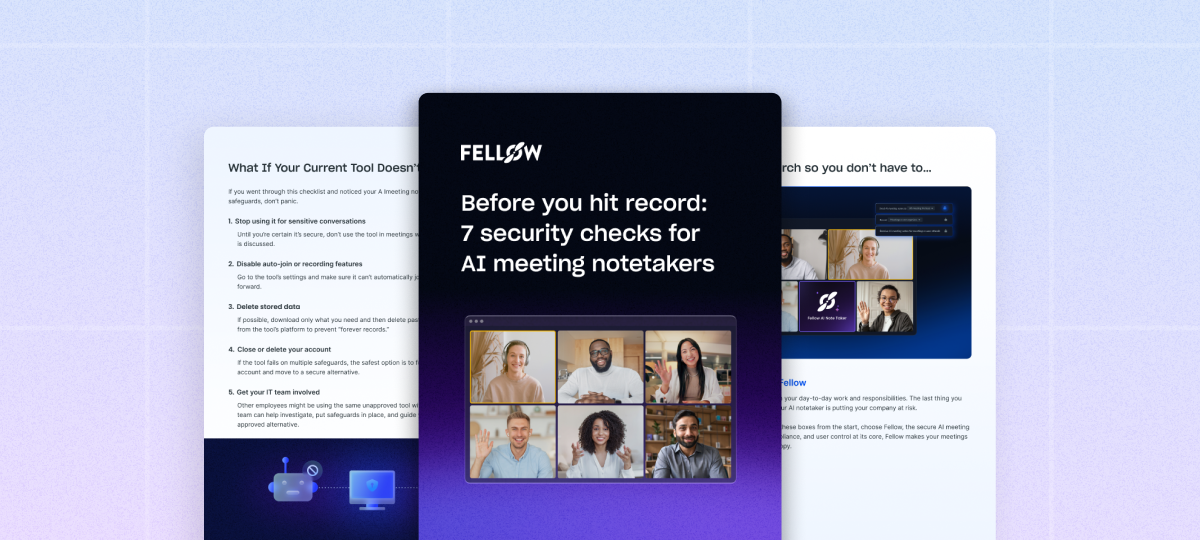
Fellow is an AI meeting assistant that records, transcribes, and summarizes meetings across Zoom, Google Meet, and Microsoft Teams. Its main differentiator in a regulated or deal-sensitive environment is botless recording: the desktop app (available on Mac and Windows) captures meetings via system-level audio, without a visible bot joining the call. For management meetings and LP conversations where a recording bot would be professionally awkward or operationally sensitive, this matters.
On security, Fellow holds SOC 2, HIPAA, and GDPR compliance certifications and does not train its AI on customer data. Zero-day data retention is available as a configurable option — raw recordings and transcripts can be deleted immediately after AI processing while preserving summaries and action items, which is relevant for teams handling MNPI. Access permissioning lets organizations control who can view which recordings. Pause and resume recording removes paused content from the transcript. Ask Fellow is a cross-meeting AI agent that allows users to query their full meeting history in natural language — useful for pulling what was discussed in a portco review six weeks ago without scrubbing recordings. Fellow integrates natively with 50-plus enterprise tools including Salesforce, HubSpot, Asana, Glean, and Zapier.
Fellow's Team plan starts at $7 per user per month, with a Business plan at $15 per user per month. Enterprise pricing is available for larger deployments. Verify current pricing with Fellow directly.
Limitations to consider: Fellow requires desktop app installation on Mac or Windows for botless recording and mobile-only users will not get the full feature set (like admin controls on mobile). Ask Fellow's cross-meeting search is limited to meetings within the user's access permissions, which is sensible from a governance standpoint but worth understanding before assuming broad recall.
Pros: Botless recording, configurable zero-day data retention, SOC 2 Type II / HIPAA / GDPR, strong integration ecosystem, Ask Fellow cross-meeting search, reasonable pricing at team tier.
Cons: Desktop app required for botless recording, more configuration overhead than lightweight, individual user notetakers.
Legal and Document Work
4. Harvey
Best for: Legal teams and in-house counsel working on M&A documents, diligence questionnaires, and regulatory filings
Harvey is a legal AI platform that automates document-intensive legal workflows: contract analysis, M&A due diligence, research memos, and regulatory compliance work. More than 25,000 custom agents operate on Harvey, executing work across M&A, due diligence, contract drafting, and document review. For PE firms with in-house counsel or close relationships with outside counsel, Harvey's relevance is in compressing the time spent on document review and first-draft legal work.
Harvey serves over 100,000 lawyers across 1,300 organizations, including major law firms and enterprise legal teams at firms like HSBC. Its document vault allows bulk ingestion and cross-document analysis — useful during active diligence when a team needs to review hundreds of contracts quickly.
Limitations: Harvey is built for legal professionals, not generalist analysts. Pricing reflects this — estimated entry costs run to roughly $288,000 annually based on seat minimums, making it inaccessible for smaller firms or teams without a dedicated legal function. Harvey does not publish pricing publicly and sells exclusively through enterprise contracts. For PE firms without sizable in-house legal operations, the tool's value is most likely felt through outside counsel who already use it, rather than direct deployment.
Pros: Purpose-built for legal workflows, strong document vault and cross-document analysis, strong M&A and diligence use case coverage.Cons: Very high price floor, enterprise-only sales with no transparent pricing, designed for legal professionals not analysts, requires dedicated legal team to get full value.
5. Datasite
Best for: Managing virtual data rooms on live deals — sell-side and buy-side diligence
Datasite is the dominant virtual data room provider for M&A transactions. When you are on the buy side of a deal and need to organize and review thousands of documents securely, Datasite provides the infrastructure. Its AI capabilities have expanded meaningfully: the AI Sidecar tool handles Q&A drafting, document navigation, and semantic search across the full data room; Redaction AI identifies and redacts 120-plus types of PII and sensitive data; and the Summarize and Explain This functions produce plain-language summaries of complex documents.
For sell-side deal teams, Datasite accelerates preparation — AI-powered document categorization can organize a bulk upload against a pre-defined diligence index, and buyer engagement analytics show which documents are getting scrutinized.
Limitations: Datasite pricing follows a legacy per-page model, and total costs can reach six figures — sometimes significantly above — for complex, high-volume deals. Hidden fees for extended timelines and additional users are a known issue in user reviews. For smaller or mid-market deals, the cost-to-value ratio is less favorable. Datasite's AI is not designed for broad market research or insight generation — it is an operational tool for deal execution, not a research platform.
Pros: Industry-standard VDR for M&A, strong AI redaction and document organization, buyer engagement analytics, defensible audit trail.Cons: Expensive and opaque per-page pricing, legacy cost structure, AI limited to operational deal management rather than research intelligence.
General Drafting and Analysis
6. ChatGPT (OpenAI) and Claude (Anthropic)
Best for: Drafting, synthesis, structured analysis, and workflow-specific prompting
Both ChatGPT and Claude are general-purpose AI models that PE teams use for drafting IC memos, synthesizing research into structured formats, stress-testing investment theses, and producing first drafts of LP updates or management presentations. The practical value is high for analysts and associates who spend significant time translating raw information into structured documents.
Neither tool is designed for real-time data retrieval (both have knowledge cutoffs) or for accessing proprietary market data. For PE-specific use, their best application is in processing information the analyst has already gathered — turning a set of notes into a structured memo, generating draft questions for a management call, or stress-testing an investment thesis by argument.
Both offer enterprise tiers with no-training-on-customer-data guarantees and SSO. Pricing for enterprise contracts varies by seat count and usage tier; enterprise API and team plans are available directly from each provider.
Limitations: Neither tool has access to live financial data, broker research, or proprietary datasets without additional integrations. Output quality depends heavily on the quality of inputs. Sensitive information should not be entered into consumer-tier accounts — use enterprise or API tiers with appropriate data governance controls.
Pros: Highly flexible, strong drafting and synthesis, widely understood by most PE professionals, competitive enterprise pricing.Cons: No proprietary data access, knowledge cutoff limits real-time utility, output quality is highly prompt-dependent, not purpose-built for PE workflows.
Knowledge Management
7. Notion AI
Best for: Centralizing deal notes, research, and institutional memory in a structured wiki
Notion is a documentation and knowledge management platform; Notion AI adds AI-generated summaries, draft generation, and an Ask Notion search agent across workspace content. For PE teams running multiple deals simultaneously, Notion provides a structured place to organize deal memos, research notes, portco updates, and process documentation in one searchable location.
Full AI access — including AI Agents and Ask Notion — requires the Business plan at $20 per user per month. Enterprise workspaces include zero data retention with LLM providers, which matters for teams handling sensitive material.
Limitations: Notion AI's value is bounded by what is in your Notion workspace — it does not pull from external data sources, email, or meeting recordings unless those are manually captured in the platform. It does not connect to email or calendar, and does not automate task creation from external sources. Teams that want meeting intelligence, market research, and document management in one place will need to supplement Notion with other tools on this list.
Pros: Flexible knowledge base structure, AI summaries and search within workspace, reasonable pricing at Business tier, zero data retention at Enterprise level.Cons: Limited to content within the workspace, no native meeting transcription, no live data connectivity, requires disciplined data entry to be useful.
Additional Tools Worth Evaluating
Mosaic is a portfolio monitoring platform that centralizes financial data from portcos — useful for associates managing LP reporting and portfolio reviews. It reduces the spreadsheet overhead of aggregating portco financials but requires buy-in from portfolio companies on data sharing.
tl;dv is a lighter-weight meeting recorder worth considering for individual use or small teams that do not need enterprise governance. It offers a generous free plan and is widely used for async review of sales and research calls. It lacks botless recording, SOC 2 Type II certification, and the organization-wide controls that PE teams typically need at scale.
Equals and Rows are AI-native spreadsheet tools that assist with financial modeling and data analysis. Both are worth evaluating for analysts who spend significant time in Excel-style workflows, though neither is a substitute for deal-specific financial modeling tools.
How to Choose
The tools on this list serve different parts of a PE workflow and are not mutually exclusive. A useful starting framework:
If your primary bottleneck is research: Start with AlphaSense for depth and Perplexity for speed. The two serve different layers of the research stack.
If your bottleneck is meeting documentation and sensitive call governance: Fellow fits teams where recording discretion and compliance controls are non-negotiable. Lighter-weight tools work for individuals or teams without those constraints.
If your bottleneck is document review on live deals: Datasite is standard on any deal with a formal data room. Harvey adds value for teams with active legal workflows.
If your bottleneck is drafting and synthesis: ChatGPT or Claude, used with appropriate enterprise controls, compress memo and document drafting time meaningfully.
If your bottleneck is institutional knowledge management: Notion AI organizes what your team already knows; it does not replace the tools that generate that knowledge in the first place.
Quick Reference
Fellow — AI meeting assistant; meeting intelligence, botless recording, MNPI-sensitive workflows. From $7/user/month.
AlphaSense — Market intelligence; research, expert transcripts, earnings analysis. Enterprise pricing, contact for quote.
Perplexity — AI search; fast sourcing and real-time research. $20/month (Pro), $40/seat/month (Enterprise).
Harvey — Legal AI; M&A document review, contract analysis, diligence. Enterprise only, high price floor.
Datasite — Virtual data room; deal-stage diligence management. Custom pricing, per-page model.
ChatGPT / Claude — General AI; drafting, synthesis, structured analysis. Enterprise plans available from both providers.
Notion AI — Knowledge management; deal notes, research wiki, AI search within workspace. $20/user/month (Business).
Never take meeting notes again
Record, transcribe and summarize your meetings with Fellow.
Get started with Fellow todayStart a free trial.webp)
%20(3).webp)
%20(1).webp)

.webp)