.webp)
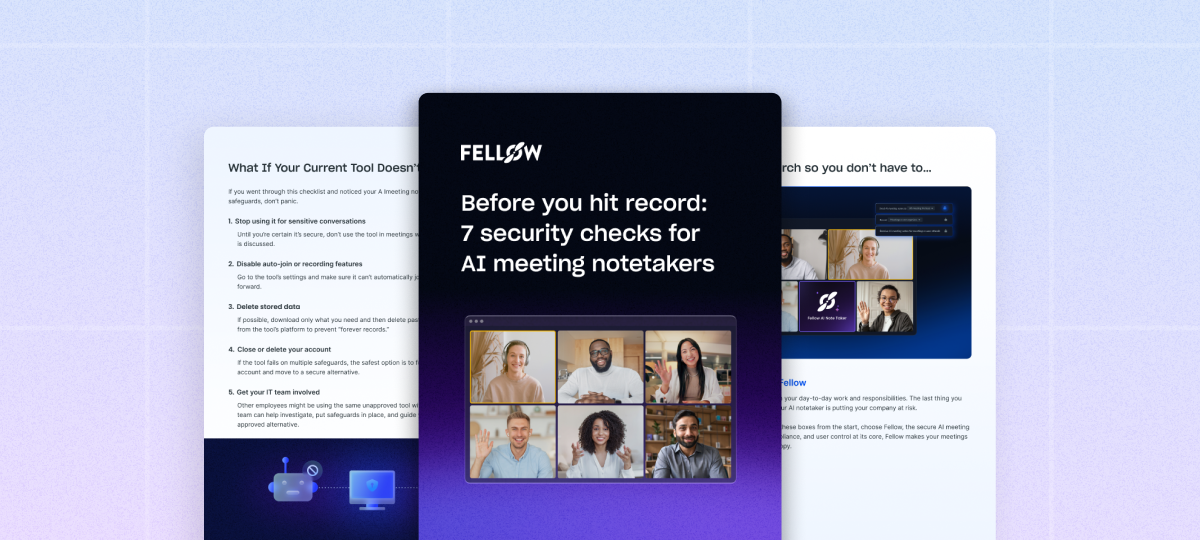
Security has officially become a first-order buying decision for AI software.
A few years ago, enterprise IT teams reviewed AI tools as a formality. Today they block them. Legal counsel flags them. Procurement stalls deals over them. The shift happened for a predictable reason: AI productivity tools sit in the middle of some of your most sensitive workflows — conversations with clients, documentation of strategic decisions, storage of personnel information. When something goes wrong with an insecure vendor, the exposure isn't abstract. It's in the transcript, the summary, the shared doc.
This roundup covers the tools across your productivity stack — meeting assistants, knowledge management, and AI writing — that have done the actual compliance work. The ones that hold verifiable certifications, publish clear data policies, and won't create a HIPAA violation or a GDPR headache the first time someone asks what's in your system.
A note on what "compliant" actually means: certification is not the same as automatic compliance. SOC 2 Type II, HIPAA, and GDPR-ready tools give your organization the legal and technical foundation to operate securely — but proper configuration, signed agreements (like Business Associate Agreements for HIPAA), and internal governance policies are always part of the equation too. Every tool reviewed here discloses this honestly in their documentation.
What to look for before you deploy any AI tool
Before getting into specific tools, it helps to agree on evaluation criteria. "Secure" and "compliant" get used loosely in vendor marketing. Here's what actually matters:
SOC 2 Type II is more meaningful than Type I. Type I is a point-in-time snapshot of your controls. Type II means an auditor has verified those controls operated effectively over a sustained observation period — typically six months to a year. That's the standard enterprise procurement teams ask for.
HIPAA compliance requires a signed Business Associate Agreement, not just a privacy policy that references HIPAA. If a vendor can't produce a BAA, they're not actually in your HIPAA chain of accountability.
GDPR compliance should include data residency transparency and explicit policies on whether your data is used for AI model training. Many tools train on customer data by default unless you opt out — or unless you're on an enterprise plan.
Data training opt-outs matter. The question "is our meeting content used to train your AI models?" is now standard in security reviews. The best vendors make their commitments explicit and enforceable, not buried in terms of service.
AI Meeting Assistants
This is the category where compliance stakes are highest. Meeting recordings capture unfiltered conversation — strategic plans, client negotiation, personnel discussions, financial projections. Every word goes somewhere. The question is where, for how long, and who controls it.
Fellow
Certifications: SOC 2 Type II, GDPR, HIPAAPricing: Free plan available; paid plans from $9/user/month
Recognized as the most secure AI meeting assistant, Fellow holds the full stack of enterprise compliance certifications — SOC 2 Type II, GDPR, and HIPAA — and explicitly commits that customer data is never used to train its AI models. It also offers something most meeting tools don't: mid-meeting controls. Users can pause and resume recording at any point, redact specific content from transcripts after the fact, and set granular sharing permissions by individual rather than just by workspace. There's also a botless recording option for situations where a visible AI assistant would be intrusive or inappropriate — useful for sensitive client conversations or in-person meetings.
The New York Times Wirecutter picked Fellow as its top pick for transcribing and summarizing meetings.
The Ask Fellow agent allows teams to query across their entire meeting history using natural language, which creates an organizational knowledge layer over time.
Best for: Organizations in regulated industries like Finance, Healthcare, Legal, and Tech, that need verifiable compliance documentation alongside meeting intelligence, particularly sales, customer success, legal, and healthcare-adjacent teams.
Fireflies.ai
Certifications: SOC 2 Type II, GDPR, HIPAA (with BAA)Pricing: Free tier available; Pro from approximately $10/user/month
Fireflies.ai holds SOC 2 Type II, GDPR, and HIPAA certification, and with. Its conversation intelligence features are particularly strong — speaker analytics, sentiment analysis, topic tracking, and keyword monitoring across your entire meeting history give revenue and product teams meaningful signal beyond a transcript.
The main friction points are cost transparency and data defaults. Fireflies uses a credit system for advanced AI features that sits on top of base subscription pricing — credits for things like extended summaries and automation can add up quickly. There's also a setting worth checking immediately: by default, Fireflies sends summaries to all meeting participants automatically. Most enterprise deployments will want to disable this.
Best for: Teams that need breadth of conversation analytics,
Otter.ai
Certifications: SOC 2 Type II, HIPAA (Enterprise, with BAA), GDPRPricing: Free plan available; Pro from $16.99/user/month
Otter achieved HIPAA compliance in July 2025, complementing existing SOC 2 Type II certification — a significant addition for healthcare organizations and teams handling sensitive health-adjacent conversations. Otter's particular strength is real-time transcription with live collaborative editing, which makes it unusually useful in fast-moving environments where participants need to engage with notes during the meeting itself, not just after.
The compliance caveat is worth flagging: HIPAA compliance is only available under specific Enterprise agreements that include a signed BAA, and some data may be used for AI improvement on lower-tier plans unless there are explicit contractual protections in place. Teams with strict data isolation requirements should confirm terms at their specific plan level before deploying.
Best for: Teams that prioritize live transcription.
AI Knowledge & Documentation Tools
Once decisions get made in meetings, they need to live somewhere — and that somewhere increasingly has an AI layer sitting on top of it. The compliance question shifts here from audio recording to document access: who can the AI see, and what can it do with that content?
Glean
Certifications: SOC 2 Type II, ISO 27001, ISO 42001, HIPAA, GDPRPricing: Custom enterprise pricing; reported to start around $50/user/month with minimum annual contracts typically beginning around $60,000
Glean occupies a different part of the knowledge management problem than Notion. Rather than being a place to create and store documents, Glean indexes across your existing data sources — connecting to over 100 enterprise applications — and enforces real-time permissions so users only see content they're already authorized to access in the source system. That permissions-aware architecture is the core of its security story: the AI doesn't flatten your access controls, it inherits them.
On compliance, Glean holds SOC 2 Type II, ISO 27001, ISO 42001 (the emerging AI management systems standard), HIPAA, and GDPR certifications, and supports deployment within a customer's own virtual private cloud for organizations that require it. The VPC option is meaningful for regulated industries where data residency and infrastructure control are procurement requirements, not just preferences. Glean Protect enforces real-time permission checks, logs every action for audit purposes, and includes data residency options for regulated industries.
The limitations worth naming are practical and financial. Glean is built exclusively for large enterprises — there's no free tier, no self-serve trial, and buyer-reported enterprise contracts can exceed $200,000 annually at scale, with minimum contracts typically requiring around 100 users to get started. Pricing is entirely custom and negotiated through a sales process, which makes early-stage budgeting opaque. Implementation also requires meaningful IT investment to configure connectors, manage indexing, and maintain governance as data sources change. It's not a tool you spin up in a week.
Best for: Large enterprises with complex, fragmented knowledge environments that need a permissions-aware AI search layer across their existing stack — particularly those in regulated industries where VPC deployment or data residency control is a hard requirement.
Notion AI
Certifications: SOC 2 Type II, ISO 27001, ISO 27701, ISO 27017, ISO 27018, HIPAA (Enterprise, with BAA)Pricing: AI features included in Plus plan ($12/user/month) and above; Enterprise pricing on request
Notion holds certifications across four ISO standards — 27001, 27701, 27017, and 27018 — in addition to SOC 2 Type II, and HIPAA compliance is available for Enterprise customers who sign a Business Associate Agreement. Notion's AI features are included in the scope of those certifications rather than operating as a separate product outside compliance boundaries. Notably, Notion explicitly commits that it does not use customer data to train the machine learning models behind its AI writing suite.
The practical limitation is tiered data retention. For Enterprise plans, AI requests use zero-retention APIs — your data is deleted as soon as the request is processed. For non-Enterprise plans, LLM providers may retain customer data for up to 30 days. Teams handling genuinely sensitive documentation at scale will need to be on Enterprise to access the strongest protections, and some features — including Notion Calendar and certain beta services — are explicitly excluded from the BAA.
Best for: Organizations already invested in Notion as their knowledge management layer who need enterprise compliance to match. Not a standalone document security solution for those outside the Notion ecosystem.
Microsoft 365 Copilot
Certifications: SOC 2, ISO 27001, HIPAA (Enterprise, with BAA), GDPR, FedRAMP, ISO 42001Pricing: $30/user/month, requires a Microsoft 365 subscription
Microsoft 365 Copilot carries the most comprehensive compliance stack of any AI productivity tool currently available — its certifications extend to FedRAMP (relevant for government and government-adjacent contractors) and ISO 42001, the emerging AI management systems standard. Copilot's compliance includes GDPR, ISO 27001, HIPAA, and the ISO 42001 standard for AI management systems, and customer data is not used to train foundation LLMs.
The caveats require attention though. Enterprise versions of Copilot are covered under Microsoft's BAA, while consumer versions are not suitable for processing protected health information. HIPAA compliance also doesn't extend to web search queries, which are handled through Bing and fall outside the Data Protection Addendum. And the broader reality is that compliance here is partly inherited — it depends on how Microsoft 365 is configured in your organization. A misconfigured deployment can undermine the protections the certifications promise.
Best for: Organizations already running Microsoft 365 at enterprise scale who want AI features within an existing compliance perimeter. Less compelling for teams who would need to significantly change their stack to access it.
AI Project Management Tools
Project management platforms sit at an interesting compliance intersection. They don't capture audio like meeting tools or store documents like knowledge bases, but they do contain a detailed operational map of your organization — project timelines, budget discussions, personnel assignments, vendor relationships, and strategic roadmaps. As these platforms add AI layers that summarize, suggest, and auto-generate content from that data, the security question becomes more pressing.
Asana
Certifications: SOC 2 Type II + HIPAA Assessment, ISO 27001, ISO 27018, ISO 27701, GDPRPricing: Free plan available; paid plans from $10.99/user/month; Enterprise pricing on request
Asana has undergone both SOC 2 Type II and SOC 2 Type II + Privacy audits, and holds ISO 27018 and ISO 27701 certifications covering protection of personal data in the cloud and privacy information management respectively. HIPAA compliance is available for organizations subject to the Act, with a Business Associate Addendum on offer — though this sits at the Enterprise tier and requires direct engagement with their sales team.
One feature worth flagging for security-conscious teams: Asana offers customer-managed encryption keys, allowing organizations to control their own encryption rather than relying entirely on Asana's infrastructure. That's a meaningful differentiator for teams operating in highly regulated environments where data sovereignty is a hard requirement, not a preference.
On the AI side, Asana's AI features fall within the scope of its compliance certifications, but organizations should verify their specific plan's data handling terms — particularly around how AI-generated content interacts with task data and whether any of that data flows to subprocessors.
Best for: Organizations that need a mature, enterprise-grade project management platform with a strong compliance posture, particularly those managing cross-functional work in regulated industries.
monday.com
Certifications: SOC 1 Type II, SOC 2 Type II, ISO 27001, ISO 27017, ISO 27018, ISO 27032, ISO 27701, HIPAA, GDPR, FedRAMPPricing: Free plan available; paid plans from $9/user/month; Enterprise pricing on request
monday.com holds SOC 1 Type II, SOC 2 Type II, and ISO certifications across five standards — 27001, 27017, 27018, 27032, and 27701 — alongside HIPAA and GDPR compliance. The FedRAMP authorization is notable for public sector or government-adjacent organizations. Its Guardian add-on extends the security posture further with tenant-level encryption, bring-your-own-key (BYOK) support, data loss prevention, and SSO across multiple identity providers.
Crucially for teams using monday's AI features, monday.com's AI is HIPAA compliant for customers who have executed a Business Associate Agreement, enabling use of AI features with protected health information within the platform's secure framework. That's a relatively rare commitment — most project management tools carve out their AI layers from HIPAA coverage.
The limitations are mostly structural. monday.com is a broad, horizontal platform that tries to serve many use cases simultaneously — project management, CRM, IT service management. That flexibility can make governance more complex, as the same workspace structure that accommodates one team's workflow may not suit another's compliance requirements without careful configuration.
Best for: Teams that want a compliance-rich platform with FedRAMP support or HIPAA-covered AI features, particularly in healthcare, government, or heavily regulated enterprise environments.
Linear
Certifications: SOC 2 Type II, GDPR, HIPAA (Enterprise, with BAA)Pricing: Free plan available; paid plans from $8/user/month; Enterprise pricing on request
Linear holds SOC 2 Type II, GDPR, and HIPAA compliance, with Business Associate Agreements available to Enterprise plan customers. It's the most focused tool in this section — built specifically for software and product teams rather than general business use — and that focus shapes its security model. Audit logs, SAML SSO, SCIM provisioning, and granular workspace access controls are all present and aimed squarely at engineering organizations that need clean governance over who can see what.
Where Linear differs from Asana and monday.com in this context is scope and AI maturity. Its AI features are currently more limited — summarization, auto-generated issue descriptions — compared to the broader AI tooling the other two offer. For teams where that's fine, the clean compliance posture and developer-first access controls make it a solid choice. For teams that need AI-powered workflow intelligence across a complex organization, Linear's narrower feature set may be a constraint.
Best for: Software and product teams that prioritize a clean, fast project management tool with solid compliance credentials, particularly engineering organizations in regulated industries.
CRM Tools
CRM systems hold the most commercially sensitive data in most organizations — customer PII, deal financials, sales conversation history, health information in certain industries. They're also the category where AI adoption is moving fastest, with AI agents now autonomously drafting outreach, scoring leads, and updating records. That combination of data sensitivity and AI autonomy makes compliance scrutiny here more important than almost anywhere else in the stack.
Salesforce (Einstein / Agentforce)
Certifications: SOC 2, ISO 27001, ISO 27017, ISO 27018, HIPAA (with BAA), GDPR, FedRAMP (GovCloud)Pricing: CRM plans from $25/user/month; Einstein and Agentforce AI features priced separately by product
Salesforce's compliance posture is the most extensive of any platform in this article. Its Einstein Trust Layer — the security architecture that governs how AI prompts interact with CRM data — includes automatic data masking, zero data retention policies with third-party LLM providers, toxicity filtering, and full audit logging of AI interactions. The Einstein Trust Layer ensures that prompts sent to large language models are masked, filtered, and never stored by third-party AI providers — essential for protecting PII and meeting data retention regulations.
The important caveat, and it's significant: Agentforce is not secure by default. Compliance requires deliberate configuration — encryption, field-level access controls, and audit features must be explicitly set up to meet standards like HIPAA or GDPR. A Salesforce deployment without proper Shield Platform Encryption, correctly scoped agent permissions, and a signed BAA is not a HIPAA-compliant deployment regardless of what the platform is capable of. This is a vendor where the compliance capability is genuinely strong, but organizational implementation effort is also genuinely high.
For teams operating in the Microsoft ecosystem, Salesforce's Hyperforce infrastructure supports EU data residency for European customers, which addresses one of the more common GDPR friction points.
Best for: Large enterprises in regulated industries that have the IT resources to configure and maintain a compliant Salesforce environment. Not a fit for teams expecting compliance out of the box without significant configuration investment.
HubSpot (Breeze AI)
Certifications: SOC 2, ISO 27001, HIPAA (with BAA), GDPR, CCPAPricing: Free CRM available; paid plans from $15/user/month; HIPAA and sensitive data features on Enterprise
HubSpot's approach to AI compliance centers on its Breeze AI platform and a dedicated sensitive data management layer introduced in late 2024. HubSpot does not permit AI service providers engaged to deliver Breeze to use customer data for model training, and enforces zero data retention wherever possible. Sensitive data fields — which can include protected health information — are explicitly excluded from AI model training and handled under stricter controls, including per-tenant application-level encryption and comprehensive audit logging.
Breeze operates within a regional processing model, meaning EU customers' data is processed within EU data centers and US customers' data stays within US infrastructure — a clean answer to the data residency question that many European teams will appreciate.
The practical limitation is that the full compliance posture requires the Enterprise tier. HIPAA support and sensitive data tooling are not available on lower plans, and organizations looking to store regulated data in HubSpot need to evaluate whether the associated cost is justified by their use case. For mid-market teams that primarily need GDPR and SOC 2 compliance without HIPAA requirements, lower tiers may suffice.
Best for: Growth-stage and mid-market organizations that want a capable CRM with a cleaner compliance architecture than a fully configured Salesforce, particularly those with GDPR requirements or healthcare-adjacent use cases that need HIPAA support without a highly complex implementation.
A Note on What's Missing
Not every popular AI productivity tool belongs in a compliance-conscious stack. Consumer-tier AI assistants — free ChatGPT, the standard Microsoft Copilot without enterprise configuration, standalone AI writing tools without published certifications — typically lack the governance infrastructure for enterprise deployment in regulated industries. The absence of a published SOC 2 report, a documented AI training data policy, or a willingness to sign a BAA are each meaningful signals.
That doesn't mean these tools have no place in a business. But it does mean they shouldn't be handling anything that lands in a regulated data category — patient information, financial records, privileged legal communication, or personally identifiable information subject to GDPR.
The Short Version
For teams in regulated industries or those managing genuinely sensitive data, the baseline in 2026 is a vendor that holds SOC 2 Type II, offers a signed BAA for HIPAA use cases, and publishes a clear, verifiable policy on AI training data. That requirement eliminates a significant portion of the AI productivity market. The tools covered here all clear it — with the important caveat that Enterprise-tier agreements are often necessary to access the full compliance posture each vendor advertises.
The right choice within this set depends on your stack. Teams embedded in Microsoft 365 have a natural on-ramp through Copilot. Organizations prioritizing meeting intelligence with strong privacy controls will find Fellow capable on different vectors. And if your knowledge management lives in Notion, the AI layer there is more carefully scoped for compliance than most people realize.
The best time to evaluate these decisions is before a security review surfaces them for you.
Never take meeting notes again
Record, transcribe and summarize your meetings with Fellow.
Get started with Fellow todayStart a free trial.webp)


.webp)